
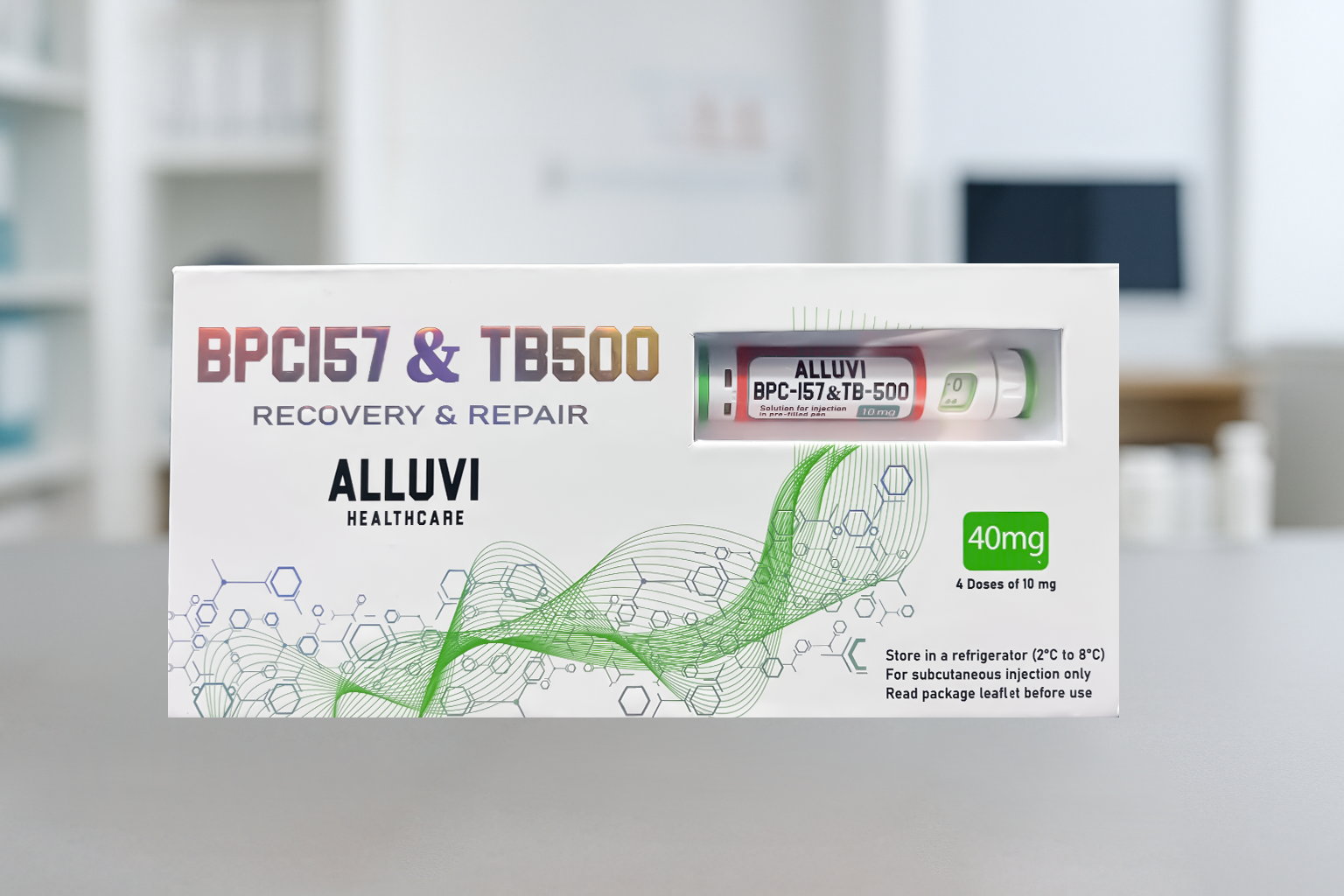
BPC157 & TB500
165.00£
Explore BPC157 TB500 research information through
Alluvi Healthcare.
BPC-157 is an investigational 15-amino-acid peptide, while TB-500 is commonly identified as a synthetic fragment related to thymosin beta-4. Review the stated contents, product format, research classification and evidence limitations carefully. Neither peptide is established as an authorised UK treatment, and any quantity shown on the listing must not be interpreted as a recommended dose.
BPC157 TB500: Research Information Without Exaggerated Claims
At
Alluvi Healthcare,
visitors can review the BPC-157 and TB-500 catalogue listings, compare the stated product formats and understand what current scientific evidence does—and does not—establish about these two investigational peptides.
BPC-157 and TB-500 are different compounds. BPC-157 is commonly described as a 15-amino-acid peptide, while TB-500 is associated with a short fragment derived from the thymosin beta-4 sequence.
Both have generated interest in laboratory and sports-recovery discussions, but neither should be presented as a clinically proven UK treatment for muscle, tendon, ligament, joint or wound injuries.
Understand the compounds, verify the exact listing and separate preclinical findings from established human outcomes.
Review the BPC157 TB500 Product Listing
Open the
BPC157 TB500 product-information page
to review the current product title, images, stated contents, presentation, price and availability.
Before proceeding, confirm:
- The complete product name
- The individual quantity claimed for each peptide
- Whether the stated total refers to one vial or the complete package
- The physical presentation shown
- The stated research classification
- The current price and pack contents
- Warnings and intended-use restrictions
- Shipping and destination limitations
- Whether supporting documentation applies to the exact supplied batch
A figure such as 10mg, 20mg or 40mg describes the quantity claimed by a catalogue listing. It must not be interpreted as a clinical dose, treatment schedule or administration recommendation.
Review the complete BPC157 TB500 listing
and verify exactly what the package is stated to contain.
What Is BPC-157?
BPC-157 is commonly described as a stable gastric pentadecapeptide consisting of 15 amino acids.
Much of the published research has investigated the compound in laboratory or animal models involving:
- Tendon and ligament injuries
- Skeletal-muscle damage
- Gastrointestinal tissue
- Blood-vessel signalling
- Inflammatory pathways
- Wound and tissue-remodelling processes
These studies have generated hypotheses about mechanisms involving nitric-oxide pathways, growth-factor signalling, angiogenesis and extracellular-matrix organisation.
However, laboratory and animal findings cannot establish that an online BPC-157 product safely repairs injuries in humans.
A
peer-reviewed sports-medicine review of BPC-157
concluded that the available evidence is dominated by preclinical research and that well-designed human trials remain necessary.
What Is TB-500?
TB-500 is commonly identified as a synthetic peptide related to the amino-acid sequence LKKTETQ found within thymosin beta-4.
The
World Anti-Doping Agency’s TB-500 research information
identifies the active content as an N-terminal acetylated fragment corresponding to residues 17–23 of thymosin beta-4.
This distinction matters because TB-500 should not automatically be described as identical to the complete naturally occurring thymosin beta-4 protein.
Thymosin beta-4 is involved in biological processes including actin binding, cell migration and tissue-response pathways. These biological roles have contributed to commercial claims surrounding TB-500.
They do not prove that an unauthorised vial labelled TB-500 contains the stated peptide or safely improves human recovery.
BPC-157 and TB-500 Are Different Peptides
BPC-157 and TB-500 are frequently sold together as a “recovery stack,” but they are not the same molecule and do not have identical proposed mechanisms.
- BPC-157 is a 15-amino-acid investigational peptide studied primarily in preclinical injury and gastrointestinal models.
- TB-500 is associated with a short thymosin beta-4 fragment and is discussed in relation to actin, cellular movement and tissue-response research.
Combining two research compounds does not automatically make either compound more effective, safer or clinically validated.
There is no established clinical evidence showing that a commercial BPC-157 and TB-500 combination produces superior human outcomes compared with rehabilitation, authorised treatment or either experimental compound alone.
What Does the Human Evidence Show?
Human evidence for BPC-157 remains limited compared with the large volume of animal and laboratory research.
A small number of reports and early studies have explored BPC-157 in humans, but these do not provide the large, independently replicated evidence base normally required to establish safety, effective dosing and treatment benefit.
A registered Phase 2 study is evaluating investigational BPC-157 alongside standard rehabilitation following acute hamstring injury.
Visitors can review the
ClinicalTrials.gov BPC-157 hamstring study
.
Registration of a clinical trial does not mean that the treatment has been proven effective. Completed results must be collected, analysed, published and evaluated before firm conclusions can be drawn.
For TB-500, the FDA states that it has not identified human-exposure data from drug products containing the thymosin beta-4 fragment.
This means claims describing TB-500 as clinically proven for human injury recovery substantially exceed the available evidence.
No Clinical Proof for the BPC157 TB500 Combination
The popularity of a combined BPC157 TB500 product is driven largely by online discussion, bodybuilding communities, informal protocols and extrapolation from separate preclinical studies.
The clinical evidence does not currently establish:
- An approved combined indication
- A validated ratio between the two peptides
- A clinically established combination dose
- Superior healing compared with standard treatment
- Long-term human safety
- Safety when combined with other peptides or medicines
Product descriptions should therefore avoid phrases such as “ultimate healing stack,” “rapid tendon repair,” “complete injury recovery” or “clinically proven regeneration.”
FDA Safety Concerns for BPC-157 and TB-500
The
FDA safety information for compounded peptide substances
identifies concerns for both BPC-157 and TB-500.
For BPC-157, the FDA highlights possible immunogenicity risks, peptide-related impurities and difficulties characterising the active pharmaceutical ingredient. It also states that available safety information is limited.
For TB-500, the FDA identifies potential immunogenicity associated with aggregation and peptide-related impurities. It also states that it has not identified human-exposure data for drug products containing the thymosin beta-4 fragment.
These concerns mean that a vial, label or certificate image cannot independently prove:
- The identity of either peptide
- The quantity claimed on the label
- The absence of related peptide impurities
- Sterility
- Endotoxin control
- Pharmaceutical manufacturing quality
- Stability during storage and delivery
- Suitability for human administration
A research label is not evidence of safety, sterility or regulatory approval.
BPC157 TB500 UK Status
BPC-157 and TB-500 should not be presented as routine authorised UK medicines for injury recovery, rehabilitation or tissue repair.
A website listing, research classification or availability for international delivery does not establish MHRA authorisation or lawful suitability for personal treatment.
Do not describe either peptide as:
- MHRA approved
- NHS approved
- A licensed sports-injury medicine
- A clinically proven recovery treatment
- Safe for unsupervised injection
- Equivalent to an authorised medicine
Regulatory status should be checked using official sources before publishing availability or treatment claims.
Important Information for Competitive Athletes
BPC-157 and TB-500 are relevant to anti-doping rules.
BPC-157 is treated as a non-approved substance under the World Anti-Doping Code, while thymosin beta-4 and derivatives such as TB-500 are included among prohibited growth-factor-related substances.
Athletes can review the current
World Anti-Doping Agency Prohibited List
.
An athlete remains responsible for prohibited substances found in their sample, including substances obtained from supplements, research products or unregulated peptide sellers.
Why Online Peptide Products Require Caution
Research peptides are frequently marketed using laboratory graphics, medical terminology and certificates that may not establish the identity of the actual supplied product.
Warning signs include:
- Guaranteed injury healing
- Claims of immediate tendon or ligament repair
- Personal dosing and injection protocols
- Claims that animal research proves human effectiveness
- No identifiable manufacturer or responsible business
- No batch-specific documentation
- Claims of sterility without appropriate evidence
- Claims of pharmaceutical grade without authorisation
- Cryptocurrency-only or untraceable payment
- Pressure to order before an injury is assessed
A musculoskeletal injury may require imaging, rehabilitation, activity modification or authorised medical treatment. Using an unidentified peptide could delay appropriate care.
Compare the Alluvi BPC-157 and TB-500 Listings
The Alluvi Healthcare catalogue contains more than one page related to these peptides.
Compare each listing independently. Similar names do not establish that both pages contain the same quantity, formulation, presentation or pack contents.
Browse the wider
BPC157 and TB500 category
for organised access to the related catalogue pages.
Internal links support catalogue navigation and product research. They do not represent recommendations for personal use.
What Smart Visitors Check Before Proceeding
Before considering any BPC-157 or TB-500 listing, verify:
- The complete product name
- The stated amount of each peptide
- The total pack contents
- The physical presentation
- The intended research classification
- The seller’s legal business identity
- Whether documentation is batch specific
- Warnings and intended-use restrictions
- Shipping and destination requirements
- Whether unsupported medical claims appear on the page
Price, packaging and confident language should not be used as substitutes for product verification.
Do not add claims such as “sterile,” “pharmaceutical grade,” “99% pure,” “clinically tested” or “guaranteed recovery” unless reliable evidence applies to the exact product and the claim is legally appropriate.
Worldwide Shipping and Product Restrictions
Review the
Alluvi Healthcare Shipping Policy
for general delivery information.
Alluvi Healthcare states that tracking information is provided when an eligible order is confirmed, with a general estimated delivery period of 2–5 business days.
Actual delivery eligibility depends on product classification, destination law, customs controls, carrier requirements and other applicable restrictions.
Worldwide shipping language does not establish that investigational peptides can legally be supplied, imported, possessed or personally administered in every country.
Customer Support and Store Information
Questions about the product listing, stated contents, live price or an existing order can be submitted through the
Alluvi Healthcare contact page
.
Customer support cannot diagnose an injury, prescribe peptides, provide injection instructions or confirm that a research product is suitable for human administration.
Review the
Alluvi Healthcare Privacy Policy
before providing personal, payment or delivery information.
Frequently Asked Questions About BPC157 TB500
What is BPC-157?
BPC-157 is an investigational 15-amino-acid peptide studied mainly in laboratory and animal models involving tissue injury and gastrointestinal processes.
What is TB-500?
TB-500 is commonly identified as an acetylated peptide fragment corresponding to part of the thymosin beta-4 sequence.
Are BPC-157 and TB-500 the same?
No. They have different amino-acid sequences, proposed mechanisms and research histories.
Why are BPC-157 and TB-500 combined?
They are commonly combined in commercial research listings because of separate preclinical interest in tissue-response pathways. This does not establish clinical benefit for the combination.
Are BPC-157 and TB-500 approved in the UK?
They should not be presented as authorised routine UK medicines for injury healing or recovery.
Is BPC-157 supported by human studies?
Human evidence is limited. A Phase 2 hamstring-injury trial has been registered, but completed clinical evidence remains insufficient.
Does TB-500 have human clinical evidence?
The FDA states that it has not identified human-exposure data from drug products containing the thymosin beta-4 fragment known as TB-500.
Are these peptides prohibited in sport?
Yes. Athletes should review the current WADA Prohibited List before considering any peptide or research product.
Does a 40mg label mean 40mg should be administered?
No. The figure describes the quantity claimed by the catalogue listing and must not be treated as a recommended dose.
Does “research use only” prove safety?
No. A research label does not prove identity, purity, sterility, approval or suitability for human administration.
Where can I compare the listings?
Review the
BPC157 TB500 listing
,
the
BPC-157 and TB-500 40mg page
and the complete
BPC157 and TB500 category
.
Review BPC157 TB500 Information Carefully
BPC157 TB500 products combine two scientifically distinct investigational peptides whose popularity currently exceeds the strength of available human evidence.
Review the exact stated contents, understand that no clinically validated combination protocol has been established and avoid treating laboratory findings as proof of guaranteed injury recovery.
Continue to the
BPC157 TB500 product-information page
and compare the related 40mg listing before proceeding.
Understand both peptides. Verify the exact product. Choose transparent evidence over exaggerated recovery claims.
Be the first to review “BPC157 & TB500”
Related products
Weight Loss
Retatrutide for sale
Weight Loss
Weight Loss
Retatrutide for sale
Reviews
There are no reviews yet.