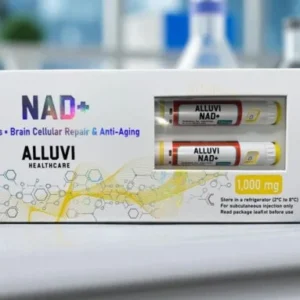
Alluvi NAD⁺ 1000mg
185.00£
Explore NAD injections and the Alluvi NAD+ 1000mg listing through
Alluvi Healthcare.
NAD+, or nicotinamide adenine dinucleotide, is an essential cellular coenzyme involved in energy metabolism and redox reactions. However, injectable NAD+ has limited clinical evidence for anti-ageing, energy, cognitive or general wellness outcomes. Review the exact product format, stated quantity, classification and supporting documentation carefully. The 1000mg figure must not be interpreted as a recommended dose.
NAD Injections: Evidence, Safety and Product Information
Searching for reliable information about NAD injections can lead to clinics, wellness providers and online product listings promising increased energy, sharper concentration, cellular repair, addiction recovery or slower ageing.
At
Alluvi Healthcare,
visitors can review the Alluvi NAD+ 1000mg catalogue listing while understanding the important difference between NAD+ biology, preliminary clinical research and claims made about a finished injectable product.
NAD+, or nicotinamide adenine dinucleotide, is a naturally occurring coenzyme found in living cells. It participates in cellular energy metabolism, oxidation-reduction reactions and several enzyme pathways involved in maintaining normal cellular functions.
These established biological roles make NAD+ scientifically important. They do not prove that injecting additional NAD+ reverses ageing, treats fatigue, improves cognition or produces another guaranteed health outcome.
Understand the molecule, verify the exact product and separate established cellular biology from unproven injectable wellness claims.
Review the Alluvi NAD+ 1000mg Listing
Open the
Alluvi NAD+ 1000mg product page
to review the current product title, images, stated quantity, physical presentation, price and availability.
Before proceeding, confirm:
- The complete product name
- Whether the stated material is NAD+, NADH, NR, NMN or another compound
- Whether the product is presented as a vial, pen, cartridge or another format
- Whether 1000mg applies to one unit or the complete package
- The number of units included
- The stated research or commercial classification
- The current price and stock information
- Warnings and intended-use restrictions
- Whether any analytical documents apply to the exact supplied batch
The 1000mg wording describes the quantity claimed by the specific catalogue listing. It must not be interpreted as a recommended injection amount, treatment schedule or administration protocol.
Review the complete Alluvi NAD+ 1000mg listing
and verify exactly what the package is stated to contain.
What Is NAD+?
NAD+ is the oxidised form of nicotinamide adenine dinucleotide. Together with its reduced form, NADH, it transfers electrons during biochemical reactions.
This NAD+/NADH cycle contributes to processes including:
- Cellular energy metabolism
- Glycolysis
- The citric-acid cycle
- Mitochondrial oxidative phosphorylation
- Redox balance
- DNA-repair enzyme activity
- Sirtuin and PARP enzyme pathways
NAD+ is therefore essential for normal biology. However, an essential molecule does not automatically become an effective anti-ageing treatment when supplied through an injection or infusion.
NAD+, NADH, NR and NMN Are Different
NAD-related terminology is often mixed together in commercial advertising.
- NAD+ is the oxidised form of nicotinamide adenine dinucleotide.
- NADH is its reduced, electron-carrying form.
- NR, or nicotinamide riboside, is a precursor the body can use within NAD-related metabolic pathways.
- NMN, or nicotinamide mononucleotide, is another NAD-related precursor.
Research involving oral NR, oral NMN, intravenous NR or another precursor should not automatically be presented as proof for direct injectable NAD+.
Check the complete ingredient identity rather than relying only on phrases such as “NAD therapy,” “NAD booster” or “cellular-energy injection.”
What Are NAD Injections?
The phrase NAD injections may refer to several different administration formats.
- Intravenous NAD+ infusion delivered through a vein
- Subcutaneous injection beneath the skin
- Intramuscular injection into muscle
- A pre-filled pen or cartridge marketed for injection
These routes are not interchangeable. They can differ in absorption, preparation, administration risks, sterility requirements and available clinical evidence.
Do not assume that evidence from a professionally monitored intravenous study applies to an online pen, self-administered injection or research-labelled vial.
What Does the Human Evidence Show?
Human research on directly administered NAD+ remains limited.
A small 2019 pharmacokinetic pilot study examined changes in NAD+ and related metabolites during a six-hour intravenous infusion. The study provided information about how infused NAD+ was processed, but it was not designed to prove anti-ageing, cognitive, energy or disease-treatment benefits.
Review the
PubMed-indexed intravenous NAD+ pilot study
.
A 2026 retrospective pilot study compared commercially administered intravenous NAD+ with intravenous nicotinamide riboside. It provided preliminary tolerability and short-term safety observations, but its retrospective design and limited scale do not establish long-term effectiveness.
Visitors can review the
2026 NAD+ intravenous tolerability study
.
Small pilot studies can generate research questions. They cannot determine that every NAD injection product is safe, effective or appropriate for general wellness use.
Does NAD Injection Therapy Reverse Ageing?
NAD biology is strongly connected with cellular metabolism and ageing research, but evidence for clinically meaningful anti-ageing outcomes in humans remains inconclusive.
A 2026 systematic review evaluated preclinical and clinical evidence involving NAD-related supplementation for anti-ageing and wellness outcomes.
The review found biological activity and promising research areas, but concluded that clinical effectiveness for broad anti-ageing and wellness outcomes remains uncertain.
Review the
2026 systematic review of NAD+ supplementation
.
Do not describe NAD injections as clinically proven to:
- Reverse biological ageing
- Increase lifespan
- Repair every damaged cell
- Prevent neurodegenerative disease
- Restore youthful metabolism
- Eliminate chronic fatigue
- Guarantee improved memory or concentration
Scientific interest in NAD-related pathways should not be converted into guaranteed human outcomes.
NAD Injections for Energy and Fatigue
NAD+ participates in reactions involved in cellular energy production. This biological fact is frequently used to market injections as immediate energy treatments.
However, feeling tired does not prove that a person has a treatable NAD+ deficiency.
Fatigue may be associated with:
- Insufficient sleep
- Anaemia or iron deficiency
- Thyroid disorders
- Infection or inflammatory illness
- Medication effects
- Depression or anxiety
- Blood-glucose disorders
- Cardiac or respiratory disease
- Other underlying health conditions
An injectable wellness product should not delay appropriate assessment of persistent or unexplained fatigue.
NAD Injections for Brain Fog and Cognitive Function
NAD+ is important to normal neuronal metabolism, but this does not establish that commercial NAD injections improve memory, attention or mental performance.
Reports of improved focus are often based on testimonials, uncontrolled observations or studies involving different NAD precursors.
Reliable claims require controlled human trials using the exact intervention, route, population and clinically meaningful outcomes.
Do not describe an NAD+ 1000mg product as proven to prevent dementia, treat cognitive impairment or restore brain function.
NAD Injections and Addiction Recovery Claims
Some clinics promote intravenous NAD+ for alcohol or substance withdrawal, craving reduction and addiction recovery.
The evidence supporting these claims remains limited and does not establish NAD+ infusion as a replacement for medically supervised withdrawal management, psychological treatment or evidence-based addiction services.
Withdrawal from alcohol, benzodiazepines and certain other substances can be medically dangerous. Anyone at risk should seek appropriate professional care rather than relying on a commercial wellness infusion.
FDA Warning About Injectable NAD+
Sterile injectable products require strict controls because contamination can enter directly into the body.
The
FDA warning concerning compounded injectable NAD+
states that some compounders used food-grade NAD+ ingredients to produce intravenous products.
The FDA explained that ingredients intended for food or dietary supplements are not automatically suitable for sterile drug compounding because of contamination risks.
The agency reported adverse events following NAD+ injectable products, including:
- Severe chills
- Shaking
- Vomiting
- Fatigue
- Reactions requiring medical treatment
These reports were consistent with excessive endotoxin exposure.
A substance suitable for a supplement or laboratory application is not automatically suitable for sterile injection.
General Injection and Infusion Risks
Any injectable or intravenous procedure can introduce risks beyond the active ingredient itself.
Potential complications can include:
- Pain or irritation at the administration site
- Bleeding or bruising
- Infection
- Inflammation of a vein
- Allergic or infusion reactions
- Incorrect preparation or dilution
- Contamination
- Incorrect administration
- Use of an unsuitable or mislabelled ingredient
Risk increases when an injection is supplied without verified sterile manufacturing, appropriate clinical oversight or clear product information.
An Online Label Cannot Prove Injectable Quality
A vial, pen, package photograph or certificate image cannot independently establish:
- That the material contains authentic NAD+
- That the stated 1000mg quantity is accurate
- The absence of chemical degradation products
- Sterility
- Endotoxin control
- Particulate control
- Approved pharmaceutical manufacturing
- Stability during storage and delivery
- Suitability for human injection
Claims such as “pharmaceutical grade,” “sterile,” “pure” or “clinically tested” require reliable evidence applying to the exact supplied batch.
Do not rely solely on a generic certificate that cannot be matched to the product’s batch identifier.
NAD+ 1000mg Is Not a Recommended Dose
The phrase “NAD+ 1000mg” may describe the total quantity claimed within the package.
It does not establish:
- A suitable amount for an individual
- A frequency of administration
- A course duration
- A safe injection route
- A clinically established treatment protocol
Product content should not include self-injection schedules, pen-click calculations, reconstitution instructions or personalised dosing advice.
NAD Injections Versus Oral NAD Precursors
Oral nicotinamide riboside and nicotinamide mononucleotide are precursors used in research examining NAD-related metabolism.
They differ from direct NAD+ injection in route, absorption and available evidence.
More published human trials involve oral precursors than direct NAD+ injection, but that does not mean every precursor product has proven anti-ageing or therapeutic effects.
Visitors should avoid transferring findings between:
- Oral NAD precursors
- Intravenous NAD+
- Intravenous nicotinamide riboside
- Subcutaneous NAD+
- Intramuscular NAD+
- Different commercial formulations
NAD Injections Are Not Vitamin B12 Injections
NAD+ and vitamin B12 are different substances with different biological roles and clinical uses.
A person who has a confirmed vitamin B12 deficiency may receive an authorised B12 medicine under professional care. This does not establish that NAD+ injections are an equivalent or approved substitute.
Do not market NAD+ as “advanced B12” or claim that the products provide identical benefits.
What Smart Visitors Check Before Proceeding
Before considering an NAD injections listing, verify:
- The precise chemical identity
- The complete product format
- The total stated quantity
- The number of units included
- The manufacturer or responsible supplier
- The intended product classification
- Whether analytical documentation is batch specific
- Whether sterility or endotoxin claims are properly supported
- Warnings and intended-use restrictions
- Shipping and destination requirements
Avoid products promoted using guaranteed anti-ageing, brain-performance, detoxification or disease-treatment claims.
Verify the exact product—not merely the NAD+ name printed on its packaging.
Browse Related Alluvi Products
Review the
Alluvi NAD+ 1000mg listing
for the current product format, stated quantity and availability.
Visitors can also browse the
Alluvi Supplements collection
for related catalogue information.
Products within this category may have different ingredients, formats, evidence levels and regulatory classifications. Internal links support catalogue navigation rather than personalised medical recommendations.
Shipping and Product Restrictions
Review the
Alluvi Healthcare Shipping Policy
for the store’s general delivery information.
Alluvi Healthcare states that tracking information is provided when an eligible order is confirmed, with a general estimated delivery period of 2–5 business days.
Actual eligibility depends on stock, product classification, destination law, customs controls, carrier requirements and other restrictions.
Worldwide shipping language does not establish that an injectable or research-format product can legally be supplied, imported or personally administered in every destination.
Customer Support and Store Information
Questions about the listing, stated quantity, live price, package contents or an existing order can be submitted through the
Alluvi Healthcare contact page
.
Customer support cannot diagnose fatigue, prescribe injections, recommend a dose or confirm that an injectable research product is suitable for personal administration.
Review the
Alluvi Healthcare Privacy Policy
before providing personal, payment or delivery information.
Frequently Asked Questions About NAD Injections
What are NAD injections?
The term can refer to intravenous, intramuscular or subcutaneous administration of nicotinamide adenine dinucleotide. The formats are not interchangeable.
What does NAD+ do in the body?
NAD+ is an essential coenzyme involved in redox reactions, cellular energy metabolism and several enzyme pathways.
Do NAD injections reverse ageing?
No high-quality evidence currently establishes that NAD injections reverse human biological ageing or increase lifespan.
Do NAD injections increase energy?
NAD+ participates in energy metabolism, but this does not prove that injections treat fatigue or provide a guaranteed energy increase.
Do NAD injections improve memory?
Reliable clinical evidence is insufficient to describe NAD injections as a proven cognitive-enhancement or dementia treatment.
Are NAD injections approved anti-ageing treatments?
NAD injections should not be presented as authorised anti-ageing medicines without an approved product and indication from the relevant regulator.
Are NAD injections risk free?
No. Injectable products can cause administration reactions and carry risks involving contamination, infection, sterility and endotoxins.
Has the FDA reported problems with injectable NAD+?
Yes. The FDA received reports including severe chills, shaking, vomiting and fatigue, with some reactions consistent with excessive endotoxin exposure.
Is NAD+ the same as NMN or NR?
No. NMN and NR are NAD-related precursors, while NAD+ is the coenzyme itself.
Is 1000mg a recommended NAD injection amount?
No. It describes the quantity claimed by a product listing and must not be treated as a recommended dose.
Where can I review the Alluvi product?
Open the
Alluvi NAD+ 1000mg product-information page
.
Review NAD Injection Claims Carefully
NAD injections are widely promoted using the established cellular importance of NAD+, but the clinical evidence supporting broad anti-ageing, energy, cognitive and wellness claims remains limited.
Review the exact format, confirm what the 1000mg figure represents and do not assume that an online injectable product has verified identity, sterility or regulatory approval.
Continue to the
Alluvi NAD+ 1000mg product page
for current catalogue information.
Understand the evidence. Verify the exact product. Never convert cellular biology into guaranteed injection claims.
Be the first to review “Alluvi NAD⁺ 1000mg”
Related products
Retatrutide for sale
Retatrutide for sale
Weight Loss
Weight Loss
Reviews
There are no reviews yet.