
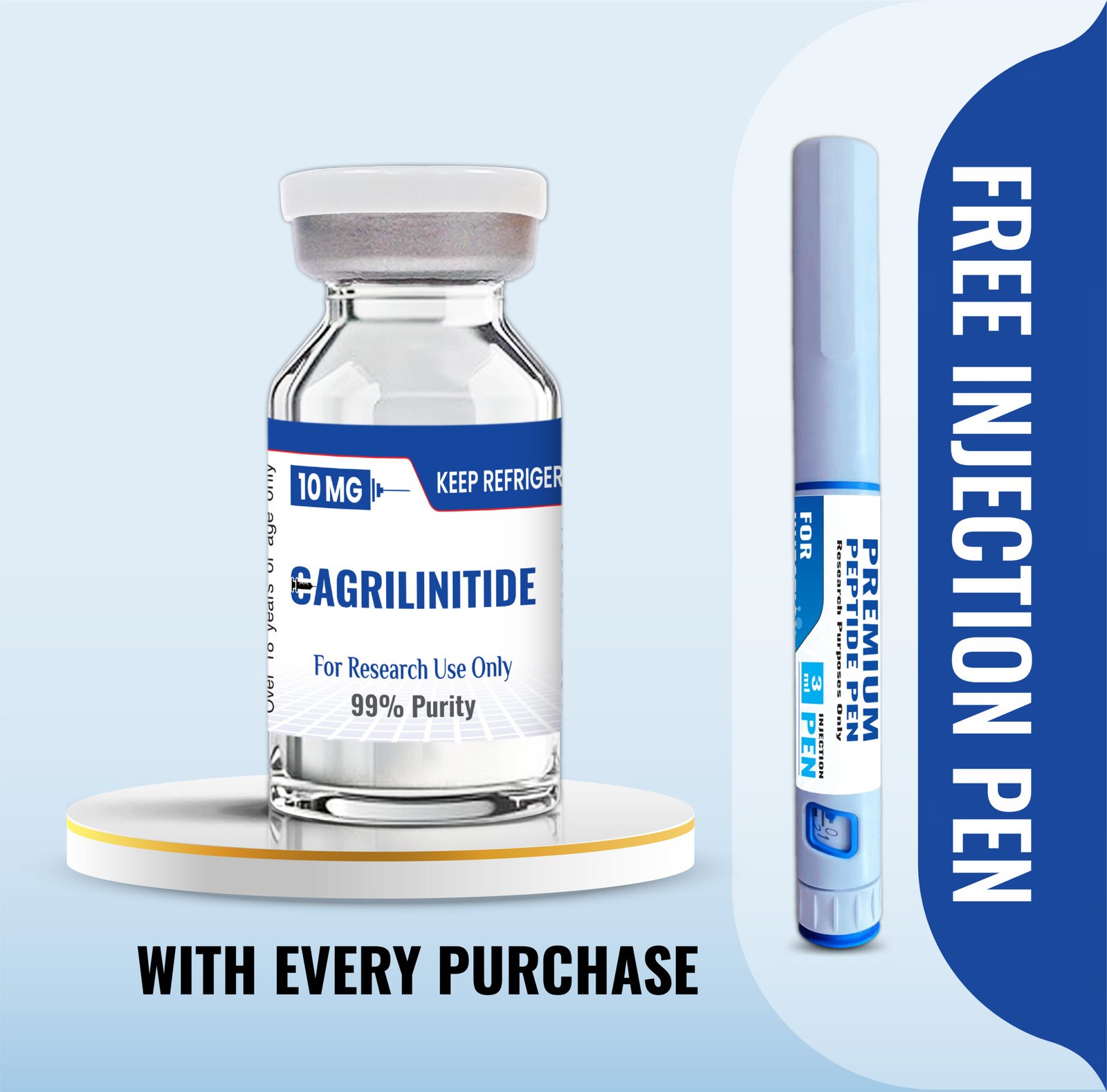
CAGRILINTIDE
175.00£
Explore the cagrilintide peptide, a long-acting investigational analogue of the naturally occurring hormone amylin. At Alluvi Healthcare, visitors can review the Cagrilintide catalogue listing, compare related metabolic-research products and understand its mechanism, Phase 3 development and evidence limitations. Cagrilintide is not currently an approved UK medicine, and the stated product quantity must not be interpreted as a recommended dose.
Cagrilintide Peptide: Explore the Amylin Research
Cagrilintide is an investigational peptide developed by Novo Nordisk. It is designed to reproduce selected biological actions of amylin while remaining active for substantially longer than naturally occurring human amylin.
It is being studied independently and as one component of CagriSema, a fixed-dose investigational combination containing cagrilintide and semaglutide.
Understand the peptide, verify the exact listing and separate controlled clinical research from unsupported commercial claims.
Review the Cagrilintide Product Listing
Open the
Cagrilintide product-information page
to review the live product title, images, stated quantity, physical presentation, current price and availability.
Before proceeding, confirm:
- The exact product title
- The quantity claimed by the listing
- The physical product presentation
- The stated research classification
- The live price and pack contents
- Storage and shipping information actually provided
- Destination restrictions
- Warnings and intended-use limitations
- Whether any supporting documents apply to the exact supplied batch
A quantity shown on a research-product page must not be interpreted as a clinical dose, treatment schedule or instruction for human administration.
Review the complete Cagrilintide listing
and confirm exactly what the product page represents.
What Is Cagrilintide?
Cagrilintide, also identified in scientific development as NNC0174-0833, is a chemically modified, long-acting analogue of the peptide hormone amylin.
Amylin is naturally released from pancreatic beta cells alongside insulin after food is consumed. It participates in biological signalling associated with meal-related satiation, food intake, gastric emptying and glucose regulation.
Natural human amylin is unsuitable for convenient long-duration use because it has limited stability and can form aggregates. Cagrilintide was engineered to improve stability and extend biological activity.
The
peer-reviewed development study for cagrilintide
describes the scientific modifications used to create a long-acting amylin analogue for clinical investigation.
Is Cagrilintide a Peptide?
Yes. Cagrilintide is a synthetic peptide analogue based on the structure and biological actions of amylin.
The word “peptide,” however, does not automatically mean that a product is:
- An ordinary nutritional supplement
- An approved medicine
- Suitable for self-administration
- Sterile
- Pharmaceutical grade
- Legally available for personal treatment
Peptides can be studied as laboratory reagents, cosmetic ingredients, diagnostic tools and potential medicines. The exact product classification and evidence must therefore be assessed independently.
How the Cagrilintide Peptide Works
Cagrilintide acts as a long-acting agonist at receptors involved in amylin signalling.
Amylin-related signalling is studied in connection with:
- Meal-related satiation
- Reduced food intake
- Gastric-emptying regulation
- Glucose-related hormonal responses
- Reward-related and homeostatic feeding pathways
Preclinical research indicates that cagrilintide’s body-weight effects are mediated through brain amylin receptors rather than GLP-1 receptors.
This mechanism differentiates cagrilintide from semaglutide and tirzepatide, although all three compounds are being investigated or used within metabolic-disease research and treatment.
Review the
peer-reviewed cagrilintide mechanism study
for detailed preclinical evidence concerning amylin-receptor pathways.
Current Cagrilintide Clinical-Development Status
Cagrilintide remains investigational and cannot yet be prescribed as an approved standalone medicine.
Following encouraging earlier trials and active-comparator data from the REDEFINE programme, Novo Nordisk advanced standalone cagrilintide into Phase 3 development.
Current Phase 3 studies are examining cagrilintide in adults with overweight or obesity, including populations with and without type 2 diabetes.
The
ClinicalTrials.gov Phase 3 cagrilintide study
clearly identifies cagrilintide as an investigational medicine that doctors cannot yet prescribe.
Trial enrolment, a paediatric investigation plan or the beginning of Phase 3 development does not constitute marketing authorisation.
Is Cagrilintide Approved in the UK?
Cagrilintide is not currently authorised as a routine UK medicine.
A July 2026 MHRA paediatric-development record lists cagrilintide as a proposed subcutaneous solution for obesity and states that an invented product name is not yet available.
The
MHRA cagrilintide paediatric investigation record
documents development planning—not approval for public supply.
Do not describe cagrilintide as MHRA approved, NHS available, routinely prescribable or authorised for public weight-management treatment unless its regulatory position changes.
What Earlier Cagrilintide Trials Found
A multicentre Phase 2 study evaluated once-weekly cagrilintide in adults with overweight or obesity.
The study reported statistically significant body-weight reductions compared with placebo and supported continued development of long-acting amylin analogues.
Visitors can review the
PubMed-indexed Phase 2 cagrilintide trial
.
These findings apply to the investigational product used within the controlled study. They do not authenticate unrelated commercial vials or guarantee that an online research product will produce comparable results.
Cagrilintide Versus CagriSema
Cagrilintide and CagriSema are related but not identical.
- Cagrilintide is the long-acting amylin analogue studied as a standalone investigational compound.
- CagriSema is a fixed-dose investigational combination containing cagrilintide and the GLP-1 receptor agonist semaglutide.
CagriSema has been studied in Phase 3 programmes involving overweight, obesity and type 2 diabetes.
Novo Nordisk reported in February 2026 that CagriSema produced greater average reductions in HbA1c and body weight than its individual components in the REIMAGINE 2 study.
Review the
official Novo Nordisk REIMAGINE 2 announcement
for the company’s Phase 3 results and development status.
CagriSema was submitted to the US FDA for weight management in December 2025, but submission does not mean approval. Cagrilintide alone remains a separate investigational programme.
Cagrilintide Versus Semaglutide
Cagrilintide and semaglutide target different receptor systems.
- Cagrilintide is a long-acting amylin-receptor agonist.
- Semaglutide is a GLP-1 receptor agonist available in authorised medicines for defined medical uses.
Their different mechanisms are one reason they have been investigated together within CagriSema.
Visitors can review the
Semaglutide product-information page
,
the
Wegovy catalogue information
and the
Rybelsus product page
.
These links support catalogue comparison. The products have different approval statuses, formulations, indications and instructions.
Cagrilintide Versus Tirzepatide
Cagrilintide and tirzepatide are also different molecules.
- Cagrilintide acts through amylin-receptor pathways and remains investigational.
- Tirzepatide activates GIP and GLP-1 receptors and has authorised UK uses under the Mounjaro brand.
Compare the
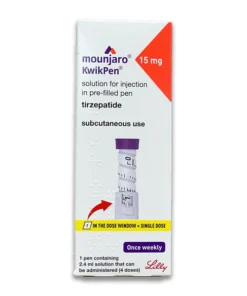
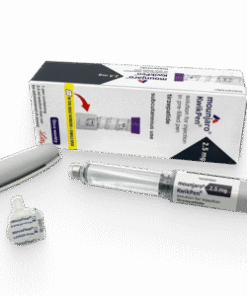
Mounjaro product-information page
and the
Tirzepatide catalogue listing
.
An authorised tirzepatide medicine should not be replaced with an unapproved cagrilintide product based on social-media advice or an online peptide protocol.
Possible Effects Reported in Clinical Research
Clinical studies of cagrilintide and CagriSema have commonly reported gastrointestinal adverse events.
Reported effects have included:
- Nausea
- Vomiting
- Diarrhoea
- Constipation
- Reduced appetite
- Abdominal symptoms
The frequency and severity of adverse events depend on the investigational regimen, population and study design.
These trial observations must not be converted into self-treatment advice. Complete long-term safety assessment and regulatory review remain necessary.
Why Online Cagrilintide Products Require Caution
Growing public interest has led to websites and social-media sellers offering products labelled as cagrilintide before regulatory approval.
A label, product photograph or certificate image cannot independently establish:
- That the vial contains cagrilintide
- That the stated quantity is accurate
- That peptide-related impurities are controlled
- That the material is sterile
- That endotoxin levels are acceptable
- That it was manufactured under pharmaceutical standards
- That it remained stable during shipping
- That it is suitable for human administration
Clinical-trial evidence belongs to the investigational medicine manufactured, monitored and administered within those studies. It should not automatically be applied to an unrelated commercial product carrying the same name.
Research Use Does Not Mean Approved Human Use
A “research use only” or “R&D only” label does not prove product identity, purity, sterility or legal suitability for personal administration.
The product page should not include:
- Personal dosage schedules
- Reconstitution instructions
- Injection guidance
- Guaranteed weight-loss claims
- Claims of regulatory approval
- Claims that clinical results apply to the listed vial
- Unsupported purity or sterility claims
Scientific interest does not remove the need for regulatory approval, reliable manufacturing and clinical oversight.
What Smart Visitors Check Before Proceeding
Before considering a cagrilintide peptide listing, verify:
- The complete product name
- The stated quantity
- The physical presentation
- The intended research classification
- The seller’s legal business identity
- Batch-specific documentation when claimed
- Warnings and intended-use restrictions
- The privacy, refund and complaints policies
- Shipping and destination requirements
- Whether unsupported medical claims appear on the page
Do not assume that a higher price, premium package or laboratory-style design establishes pharmaceutical quality.
Verify the exact listing—not merely the scientific name printed on the product.
Browse Related Metabolic-Research Information
Visitors can browse the wider
Alluvi Healthcare Weight Loss category
for related catalogue information.
Other product pages include:
Semaglutide product information
Tirzepatide product information
Mounjaro product information
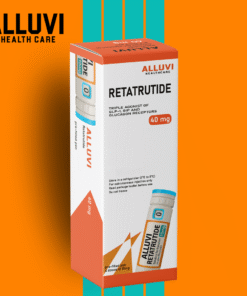
Retatrutide research information
These products have different mechanisms, evidence bases and regulatory positions. Internal links are provided for catalogue research rather than personalised treatment recommendations.
Worldwide Shipping and Product Restrictions
Review the
Alluvi Healthcare Shipping Policy
for general delivery information.
Alluvi Healthcare states that tracking details are provided when an eligible order is confirmed, with a general estimated delivery period of 2–5 business days.
Actual eligibility depends on product classification, stock, destination law, customs controls, carrier requirements and other applicable restrictions.
Worldwide shipping language does not establish that an investigational peptide can legally be supplied, imported, possessed or personally administered in every destination.
Customer Support and Store Information
Questions about the listing, stated quantity, live price, product format or an existing order can be submitted through the
Alluvi Healthcare contact page
.
Customer support cannot prescribe cagrilintide, approve an investigational product, provide injection instructions or confirm suitability for personal administration.
Review the
Alluvi Healthcare Privacy Policy
before submitting personal, payment or delivery information.
Frequently Asked Questions About Cagrilintide Peptide
What is the cagrilintide peptide?
Cagrilintide is a synthetic, long-acting peptide analogue of the naturally occurring hormone amylin.
What does cagrilintide target?
It acts through receptors involved in amylin signalling, including pathways connected with meal-related satiation and food intake.
Is cagrilintide a GLP-1 medicine?
No. Cagrilintide is an amylin analogue. It has been studied together with the GLP-1 receptor agonist semaglutide in CagriSema.
Is cagrilintide approved in the UK?
No. It remains investigational and is not currently authorised for routine public UK treatment.
Is cagrilintide currently in Phase 3 trials?
Yes. Novo Nordisk has initiated Phase 3 studies of standalone cagrilintide in people with overweight or obesity.
What is CagriSema?
CagriSema is an investigational fixed-dose combination containing cagrilintide and semaglutide.
Is CagriSema already approved?
Submission for regulatory review does not mean approval. Its status must be checked with the relevant regulator.
Is cagrilintide the same as semaglutide?
No. Cagrilintide is an amylin analogue, while semaglutide is a GLP-1 receptor agonist.
Is cagrilintide the same as tirzepatide?
No. Tirzepatide activates GIP and GLP-1 receptors, while cagrilintide acts through amylin-receptor pathways.
Does a research label prove that cagrilintide is safe?
No. A research-use label does not prove identity, purity, sterility, regulatory approval or suitability for human administration.
Where can I review the product listing?
Open the
Cagrilintide product-information page
.
Review Cagrilintide Peptide Information Carefully
The cagrilintide peptide is a scientifically important long-acting amylin analogue now being evaluated through Phase 3 clinical development.
It remains investigational, is not currently approved as a standalone UK medicine and should not be presented as an unrestricted weight-loss treatment.
Review the
Cagrilintide catalogue listing
,
compare related metabolic-research pages and examine the complete classification and evidence before proceeding.
Understand the mechanism. Verify the listing. Choose transparent scientific information over exaggerated peptide claims.
| MG | 5mg, 10mg |
|---|
Be the first to review “CAGRILINTIDE”
Related products
Retatrutide for sale
Reviews
There are no reviews yet.