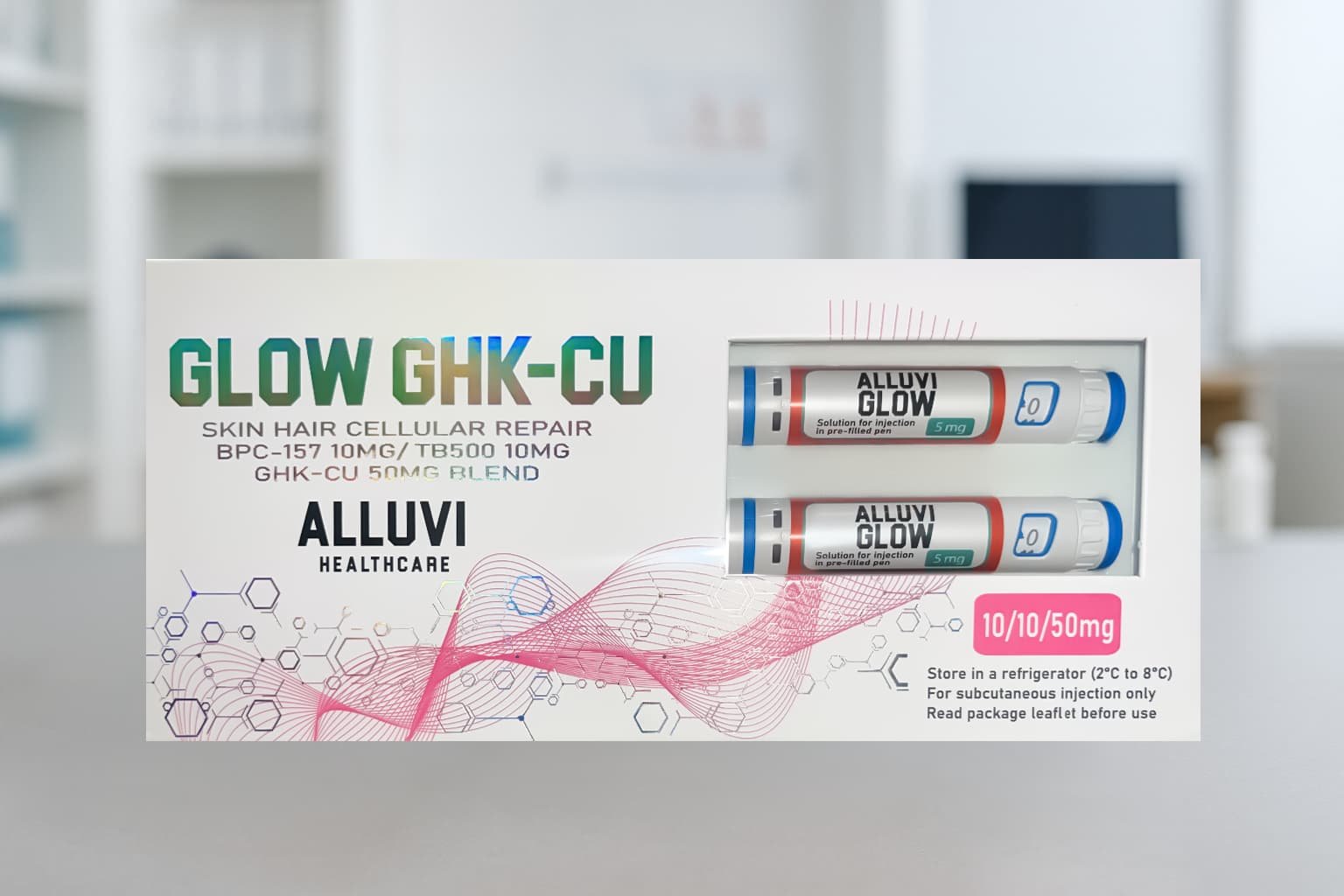
Glow GHK-Cu 70mg
135.00£
Explore GHK-Cu, also known as copper tripeptide-1, through the Glow GHK-Cu 70mg listing from Alluvi Healthcare. GHK-Cu is a copper-binding tripeptide studied in skin-conditioning, tissue-remodelling and cosmetic research. Review the stated product contents, presentation, research classification and evidence limitations carefully. The 70mg figure belongs to the specific listing and must not be interpreted as a recommended dose.
GHK-Cu: Explore Copper Peptide Research
Searching for clear, evidence-led GHK-Cu information without exaggerated anti-ageing, hair-growth or tissue-repair promises?
At Alluvi Healthcare, visitors can review the Glow GHK-Cu 70mg catalogue listing, compare related Glow products and understand what current research does—and does not—establish about this copper-binding peptide.
GHK-Cu is a complex formed when the naturally occurring tripeptide glycyl-L-histidyl-L-lysine binds to copper. It is frequently called copper tripeptide-1 in cosmetic ingredient discussions.
Laboratory and preclinical studies have examined GHK-Cu in relation to fibroblast activity, extracellular-matrix regulation, collagen synthesis, inflammatory signalling and tissue-remodelling pathways. These findings make the compound scientifically interesting, but they do not prove that every commercial GHK-Cu product delivers visible or medical results.
Understand the peptide, verify the exact formulation and separate promising research from clinically established outcomes.
Review the Glow GHK-Cu 70mg Listing
Open the
Glow GHK-Cu 70mg product page
to review the current product title, images, stated composition, presentation, price and availability.
Before proceeding, confirm:
- The complete ingredient or composition statement
- Whether the stated 70mg applies to GHK-Cu alone or the total formulation
- The product’s physical presentation
- Its cosmetic, supplement or research classification
- The quantity included in the package
- The current price and stock information
- Warnings and destination restrictions
- The supporting documentation attached to the exact listing
The 70mg wording belongs to this specific catalogue entry. It must not be interpreted as a recommended dose, treatment schedule or instruction for personal administration.
Review the complete Glow GHK-Cu 70mg listing
and confirm exactly what the stated quantity represents.
What Is GHK-Cu?
GHK is a tripeptide made from three amino acids:
- Glycine
- Histidine
- Lysine
The peptide has an affinity for copper ions, producing the complex commonly written as GHK-Cu. GHK has been identified naturally in human plasma and other body fluids, while its copper complex has been studied for possible roles in cellular signalling and tissue maintenance.
GHK-Cu should not be confused with elemental copper, an ordinary copper dietary supplement or every skincare product marketed generally as containing “copper peptides.”
What Does the Research Show?
Early experimental research focused on how GHK-Cu affects cultured cells and biological processes associated with skin structure and repair.
One original laboratory study found that GHK-Cu stimulated collagen synthesis in cultured human fibroblasts. Visitors can review the
peer-reviewed GHK-Cu collagen study indexed by PubMed
.
Other laboratory studies have examined effects involving glycosaminoglycans, metalloproteinases, fibroblast signalling and extracellular-matrix organisation.
These studies help explain why GHK-Cu is investigated in skin and tissue-remodelling research. However, cell-culture findings cannot establish what a finished commercial formulation will accomplish in humans.
Product performance may depend on:
- The amount of GHK-Cu present
- The stability of the copper-peptide complex
- The complete formulation
- The intended route of use
- Delivery through the skin
- Manufacturing and storage conditions
- The characteristics of the individual using the finished product
A scientifically active ingredient does not guarantee that every finished product is effective, stable or suitable.
GHK-Cu and Cosmetic Skin Research
Copper tripeptide-1 is widely used in cosmetic product development because of its skin-conditioning and formulation potential.
Research interest includes possible effects connected with:
- Fibroblast activity
- Collagen and extracellular-matrix regulation
- Skin firmness and elasticity measurements
- Oxidative-stress pathways
- Inflammatory signalling
- Skin-remodelling processes
Some publications report encouraging observations involving aged or photo-damaged skin. However, much of the evidence comes from laboratory work, small studies, older investigations or formulations containing multiple ingredients.
A clinical study of copper-tripeptide skincare used following carbon-dioxide laser resurfacing did not find significant objective improvements in redness, wrinkles or overall skin quality compared with the control, although participant satisfaction differed.
This mixed evidence is why GHK-Cu should not be described as guaranteed to remove wrinkles, reverse skin ageing or produce a clinical transformation.
GHK-Cu and Wound-Healing Research
GHK-Cu has been investigated in laboratory and animal models involving collagen production, extracellular-matrix accumulation, inflammation and tissue repair.
A registered Phase 2 study is currently examining whether a topical GHK-Cu gel can affect the healing of small, standardised skin wounds in healthy adults.
The
ClinicalTrials.gov GHK-Cu wound study
is designed to compare GHK-Cu gel with a vehicle gel and assess healing time, wound size, symptoms, scar quality and tolerability.
The study is ongoing and has not published completed results. Its existence does not establish that products currently sold online can treat wounds or accelerate healing.
Do not apply a general cosmetic or research-labelled product to an open wound unless the exact finished product is authorised and a qualified healthcare professional has advised its use.
GHK-Cu and Hair Research
Copper peptides are frequently promoted online for hair growth, but many claims combine results from different molecules and study types.
Some frequently cited hair-follicle research concerns AHK-Cu, or alanyl-histidyl-lysine copper, rather than GHK-Cu. These are related copper-binding peptides, but they are not identical compounds.
Laboratory or animal findings involving another copper peptide should not automatically be transferred to GHK-Cu products.
High-quality clinical evidence remains insufficient to describe GHK-Cu as a proven treatment for androgenetic alopecia, unexplained shedding or another medical cause of hair loss.
Anyone experiencing significant or persistent hair loss should consider an appropriate professional assessment rather than relying only on peptide marketing claims.
Topical GHK-Cu and Skin Delivery
The presence of GHK-Cu on an ingredient list does not automatically mean that a meaningful amount reaches deeper skin layers.
The skin’s outer barrier restricts the penetration of many hydrophilic compounds. Researchers and cosmetic formulators have therefore examined different carriers and delivery technologies designed to improve stability and topical availability.
Important formulation factors include:
- Peptide concentration
- Product pH
- Compatibility with other ingredients
- Packaging and exposure to air or light
- Preservation
- Delivery technology
A finished formulation should be evaluated as a complete product rather than judged only by the presence of the GHK-Cu name.
Injectable GHK-Cu Requires Stronger Caution
Topical cosmetic discussion must not be used to imply that injectable GHK-Cu has the same evidence or safety profile.
The
FDA information on compounded injectable GHK-Cu
states that injectable preparations may present immunogenicity risks related to peptide aggregation and peptide-associated impurities. The agency also notes that human safety information is limited.
An online vial, label or certificate image cannot independently establish:
- The peptide’s identity
- The amount present
- The absence of related impurities
- Sterility
- Endotoxin control
- Approved manufacturing standards
- Stability throughout storage and delivery
- Suitability for human injection
Do not add injection instructions, reconstitution directions, dosage schedules or systemic medical claims to this product page.
GHK-Cu Is Not an Approved Anti-Ageing Treatment
GHK-Cu is sometimes promoted using phrases such as “age reversal,” “cellular regeneration,” “complete tissue repair” and “healing peptide.”
Such language can overstate preliminary research and blur the line between cosmetic ingredients, research compounds and authorised medicines.
The current evidence does not justify claiming that GHK-Cu is clinically proven to:
- Reverse biological ageing
- Remove wrinkles permanently
- Eliminate scars
- Regrow lost hair
- Treat chronic wounds
- Repair every tissue type
- Treat inflammatory or systemic disease
Mechanistic interest and early research should be communicated accurately without converting possibilities into guaranteed outcomes.
Possible Sensitivity and Product Risks
Topical products containing peptides, copper complexes or additional active ingredients may cause irritation in some people.
Possible reactions can include:
- Redness
- Itching
- Burning or stinging
- Dryness
- Rash
- Swelling or allergic sensitivity
A reaction may result from GHK-Cu or from another ingredient such as a preservative, fragrance, solvent or additional active compound.
People with damaged skin, known metal sensitivity or an existing dermatological condition should obtain appropriate advice before using an unfamiliar topical formulation.
What Smart Customers Check Before Proceeding
Do not base a product decision only on attractive packaging, scientific terminology or a single laboratory document.
Check:
- The exact product format
- The full composition statement
- What the 70mg claim represents
- The intended product classification
- The manufacturer or responsible business
- Batch and expiry details when supplied
- The current price and pack contents
- Warnings and intended-use limitations
- Shipping restrictions
- Whether the page makes unsupported medical claims
Do not assume that a generic certificate of analysis applies to the exact item delivered. Any testing claim should be supported by relevant, batch-specific documentation.
Verify the complete product—not merely the ingredient name printed on the package.
Compare Related Glow Products
Browse the
Glow Supplements collection
for related Glow catalogue information.
Visitors researching this product range can also explore the
Glow 70mg category
.
A related catalogue entry is available through the
Alluvi Glow 70mg product page
.
Compare the composition, quantity and presentation of each listing independently. Similar Glow branding does not establish that separate products contain identical ingredients.
Worldwide Shipping and Product Restrictions
Review the
Alluvi Healthcare Shipping Policy
for general delivery information.
Alluvi Healthcare states that tracking details are provided when an eligible order is confirmed, with a general estimated delivery period of 2–5 business days.
Actual delivery depends on product classification, stock, destination law, customs controls, carrier conditions and other applicable restrictions.
Worldwide shipping language does not establish that every peptide or research-format product can legally be supplied to every destination.
Customer Support and Store Information
Questions about the product page, stated composition, live price, shipping or an existing order can be submitted through the
Alluvi Healthcare contact page
.
Customer support cannot diagnose a condition, guarantee cosmetic results, provide injection instructions or determine whether a research product is suitable for personal administration.
Review the
Alluvi Healthcare Privacy Policy
before submitting personal, payment or delivery information.
Frequently Asked Questions About GHK-Cu
What is GHK-Cu?
GHK-Cu is the copper complex of the tripeptide glycyl-L-histidyl-L-lysine.
Is GHK-Cu the same as copper tripeptide-1?
Copper tripeptide-1 is the cosmetic ingredient name commonly used for the copper complex of tripeptide-1.
Does GHK occur naturally?
GHK has been identified naturally in human plasma and other body fluids and can bind copper ions.
Is GHK-Cu proven to reverse ageing?
No. Laboratory, preclinical and limited topical evidence does not establish that GHK-Cu reverses biological ageing in humans.
Can GHK-Cu remove wrinkles?
GHK-Cu is studied in cosmetic skin-remodelling research, but a product should not guarantee wrinkle removal or permanent visible changes.
Does GHK-Cu regrow hair?
There is insufficient high-quality clinical evidence to describe GHK-Cu as a proven treatment for hair loss.
Can GHK-Cu heal wounds?
Wound-healing research is ongoing. Commercial GHK-Cu products should not be promoted as authorised wound treatments unless the exact product has the necessary approval.
Is injectable GHK-Cu approved?
Injectable compounded GHK-Cu has limited human safety data, and the FDA has identified concerns involving immunogenicity, aggregation and peptide-related impurities.
What does the 70mg label mean?
Check the complete product composition to determine whether the 70mg figure represents GHK-Cu alone or the combined contents of the formulation.
Where can I review the product?
Open the
Glow GHK-Cu 70mg listing
for the current product information.
Where can I compare related Glow products?
Browse the
Glow Supplements category
and the
Glow 70mg collection
.
Review GHK-Cu Information Carefully
GHK-Cu is a scientifically interesting copper-binding tripeptide with established relevance to cosmetic and tissue-remodelling research, but important evidence limitations remain.
Review the exact formulation, confirm what the stated 70mg represents and avoid treating laboratory findings as proof of guaranteed skin, hair, wound-healing or systemic results.
Continue to the
Glow GHK-Cu 70mg product-information page
and compare the related Glow listings before proceeding.
Understand the peptide. Verify the formulation. Choose transparent evidence over exaggerated claims.
Be the first to review “Glow GHK-Cu 70mg”
Related products
Weight Loss
Retatrutide for sale
Reviews
There are no reviews yet.