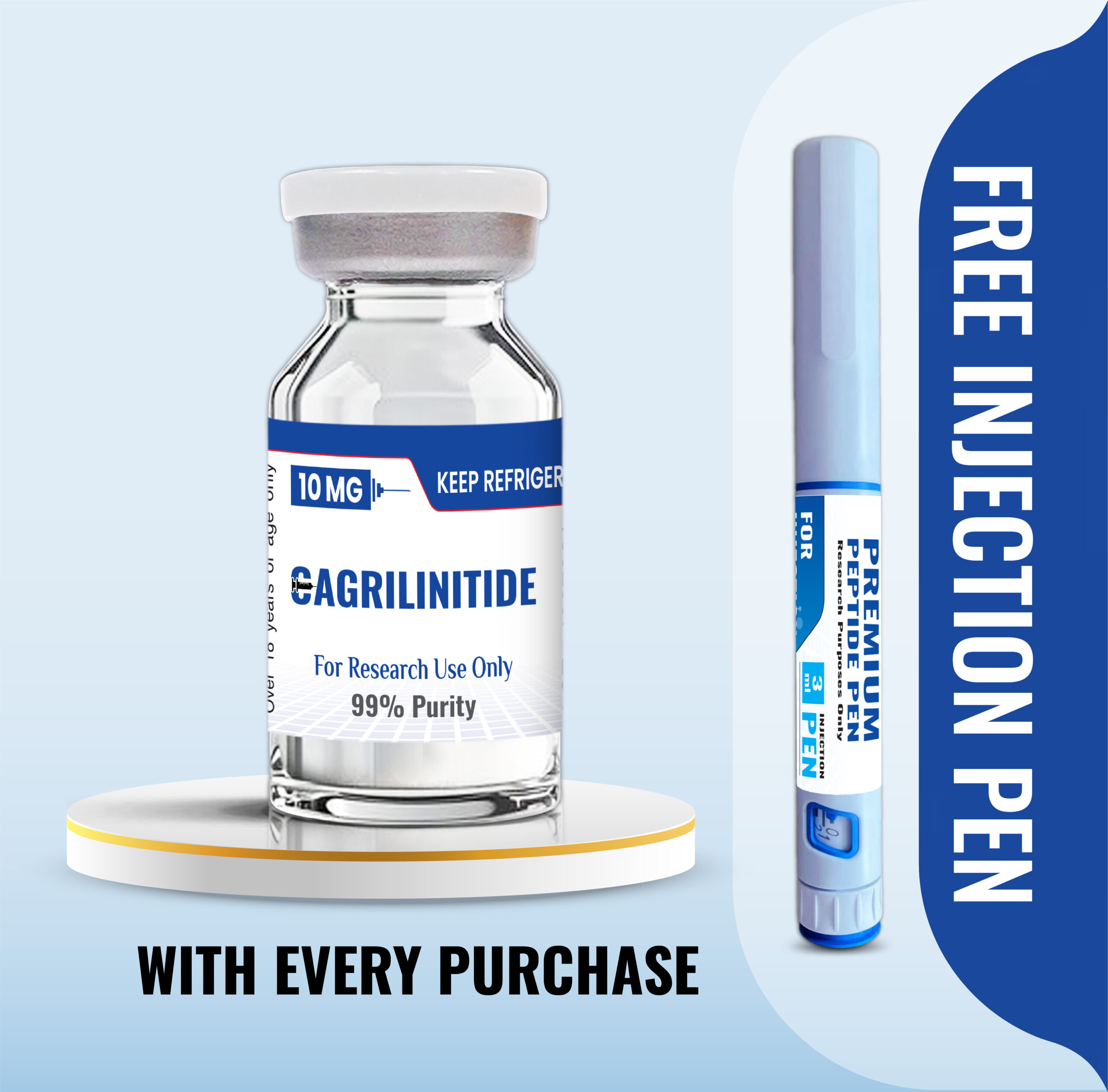
CAGRILINTIDE
Price range: £175.00 through £315.00
CAGRILINTIDE PEPTIDE – explore the scientific background of cagrilintide, its relationship with amylin signalling, ongoing clinical research and current UK regulatory considerations. This educational overview explains its investigational status and the distinction between research compounds and authorised medicines.
CAGRILINTIDE PEPTIDE: Research, Clinical Trials and UK Regulatory Information
If you are researching CAGRILINTIDE PEPTIDE, this educational guide from Alluvi Healthcare explains its scientific background, how it is being investigated, its relationship with amylin signalling and the important distinction between an investigational compound and an authorised medicine.
What Is Cagrilintide?
Cagrilintide is a long-acting amylin analogue developed for investigation in weight-management research. Amylin is a naturally occurring hormone released by pancreatic beta cells alongside insulin. It participates in appetite regulation and helps influence food intake.
Researchers are studying cagrilintide because it is designed to act on pathways associated with satiety and appetite regulation. Its development is part of wider scientific research into potential treatments for people living with overweight or obesity.
How Does Cagrilintide Work?
Cagrilintide is designed to mimic certain actions of the naturally occurring hormone amylin. Amylin-related signalling is involved in several processes associated with appetite and food intake.
Research has examined how this mechanism may influence feelings of fullness and energy intake. However, findings from clinical investigations should not be interpreted as proof that an unapproved product is safe, effective or appropriate for personal use.
CAGRILINTIDE PEPTIDE and Weight-Management Research
Cagrilintide has been investigated as a potential treatment in clinical research involving people with overweight or obesity. Studies have examined its effects alongside lifestyle interventions and have evaluated safety and changes in body weight.
It has also been studied in combination with semaglutide. This investigational combination is known as CagriSema and is designed to investigate complementary amylin and GLP-1 pathways.
Evidence from a combination product should not be confused with evidence for cagrilintide alone. The compounds, study designs and clinical findings need to be considered separately.
Cagrilintide Clinical Trials
Clinical trials are used to investigate the potential benefits, risks, tolerability and appropriate medical use of investigational compounds. Cagrilintide research includes studies examining the compound alone and research involving combinations with other medicines.
For example, public European clinical trial records include Phase III research investigating cagrilintide for weight management. These records demonstrate that clinical development is ongoing; they do not establish marketing authorisation or approval for general public use.
Researchers continue to evaluate clinical outcomes and safety information. Results should be interpreted in the context of the specific trial, its participants and its methodology.
CAGRILINTIDE PEPTIDE: UK Regulatory Status
Cagrilintide should be treated as an investigational compound rather than an established, generally authorised UK weight-loss medicine. Public European clinical trial records identify cagrilintide investigational products as not authorised.
Clinical trial participation is different from ordinary public access to a medicine. A compound being studied in a clinical trial does not mean that it has been approved for routine prescribing, pharmacy supply or general purchase.
Anyone reviewing a cagrilintide product should distinguish between clinical research material, unlicensed products and medicines that have received the necessary marketing authorisation. An online listing or research-use disclaimer does not establish that a product is lawful or suitable for human use.
Potential Risks and Research Limitations
Because cagrilintide remains investigational, its safety and effectiveness must be assessed through the relevant clinical evidence and regulatory review. Research findings cannot automatically be applied to products obtained outside controlled clinical studies.
Important considerations include:
- The difference between trial-grade material and products from unverified suppliers.
- The need for reliable evidence about identity, quality and manufacturing standards.
- Uncertainty about the safety of products that have not undergone appropriate regulatory assessment.
- The limitations of applying clinical trial findings to individuals outside the study population.
- The importance of professional medical advice when considering any weight-management treatment.
This page does not provide instructions for obtaining, preparing, dosing or administering investigational compounds.
Cagrilintide and CagriSema: Understanding the Difference
Cagrilintide is the amylin analogue being investigated on its own and in combination research. CagriSema is the name used for an investigational fixed-dose combination of cagrilintide and semaglutide.
Semaglutide acts on GLP-1 receptors, while cagrilintide is designed to act through amylin-related pathways. Combining these mechanisms is intended to investigate whether they may provide complementary effects in weight management.
The regulatory status of a combination product must be assessed separately from the status of either individual ingredient. Approval or development progress in one country does not automatically establish UK authorisation.
Weight Management Information
For general category information, see Alluvi Healthcare Weight Loss. The presence of an investigational compound in a category does not mean that it is an approved treatment, suitable for personal use or authorised for public supply.
Anyone considering medical weight-management treatment should speak with an appropriately qualified healthcare professional about authorised options and individual clinical needs.
Frequently Asked Questions About CAGRILINTIDE PEPTIDE
What is CAGRILINTIDE PEPTIDE?
Cagrilintide is a long-acting amylin analogue being investigated in clinical research, including studies involving weight management.
Is cagrilintide approved in the UK?
Cagrilintide should be regarded as investigational rather than an authorised UK weight-loss medicine. Clinical trial registration does not constitute marketing authorisation.
How does cagrilintide work?
Cagrilintide is designed to mimic certain actions of amylin, a hormone involved in appetite regulation and food intake. Its potential clinical effects remain subject to ongoing research.
What is the difference between cagrilintide and CagriSema?
Cagrilintide is an investigational amylin analogue. CagriSema is an investigational combination of cagrilintide and semaglutide, which acts through a separate GLP-1 pathway.
Are cagrilintide clinical trials still taking place?
Public clinical trial records show ongoing Phase III research involving cagrilintide. Trial status can change, so consult the relevant official trial registry for current information.
Can research cagrilintide products be assumed safe for human use?
No. A research-use label or online product listing does not establish safety, quality, regulatory approval or suitability for human use.
Official Research and Regulatory References
- European Union Clinical Trials Information System – public information about registered clinical trials.
- ClinicalTrials.gov – international clinical research records.
- Medicines and Healthcare products Regulatory Agency (MHRA) – UK medicines regulation.
- European Medicines Agency (EMA) – European medicines regulatory information.
About Alluvi Healthcare
Alluvi Healthcare provides healthcare information to help visitors understand medicines, research developments and responsible healthcare decisions. Learn more on our About Alluvi Healthcare page or contact the team through our Contact page.
Research and medical disclaimer: This page is for educational purposes only. Cagrilintide is an investigational compound and should not be presented as an authorised UK weight-loss medicine. Nothing on this page is medical advice, a treatment recommendation or an invitation to purchase or use an investigational product.
Related products
Weight Loss